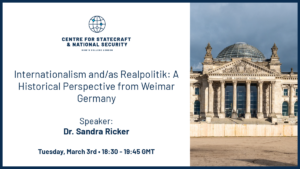
Internationalism and/as Realpolitik: A Historical Perspective from Weimar Germany with Dr Sandra Ricker
The Centre for Statecraft & National Security is delighted to host Dr Sandra Ricker for a talk on Internationalism and/as Realpolitik: A Historical Perspective from Weimar Germany.
This talk proposes returning to the First World War and its aftermath—a period of ambitious attempts to create a durable international order structured by international law—to examine the ambivalent participants in the ordering processes of the 1920s. The talk will explore currents in the Weimar Republic that sought to reconcile ‘real’ factors of political, military, and economic power with commitments to international law and the common goods, capacities, and limits safeguarded by novel international organisations, foremost the League of Nations. We will investigate, from a historical perspective, the frequent opposition drawn between the ‘realist’ dictates of statecraft and a principled commitment to international law that still echoes today.
Some of the deepest fault lines of the ‘new international order’, set down in Paris in 1919, ran through Central and Eastern Europe, and were marked by defeat, state collapse and revolution in the 1920s. The ‘new Germany’ was constituted in Weimar in this broader setting. It became a place of heightened confrontation with the crisis of the nineteenth-century order, already unsettled by globalisation and imperialist competition by the turn of the century. This encompassed a reckoning with the guiding assumptions of state sovereignty, foreign policy and international politics.
As a republic in a world of empires, Germany’s international position was uncertain, and, under unique constraints, internationalism assumed pressing significance among newly influential political forces, especially Social Democracy and democratic liberalism. This talk will present a coalition composed of their ranks, but broadening across the political spectrum, that had already pushed in this direction by the later stages of the war and struggled to win mass support. Their internationalist approach, extending into new networks and institutions, sought to ensure Germany’s full return to the international stage in greater alignment with the precepts of the ‘new international order’ and with the capacity to work towards its amendment through legalist means and in a multilateral spirit.
We will return to the contestation surrounding the conditions of legitimacy in international politics after the First World War, also to consider political parties and movements on the German Right working toward imperialist resurgence, and to look ahead to the 1930s and our present moment.
About the Speaker:
Dr Sandra Ricker is currently an Ax:son Johnson Postdoctoral Fellow at the School of Advanced International Studies at Johns Hopkins University. She completed her doctoral dissertation on German internationalism in the interwar period at the European University Institute (EUI) in Florence after studying at Heidelberg University and University College London. With her research anchored in the history of Germany and modern Europe more broadly, she is particularly interested in questions of international order, international law and imperialism/empire from the nineteenth to the twentieth centuries. Her current larger research project is a history of the prohibition of aggression in international politics and international law.
To register to attend, please click here.
