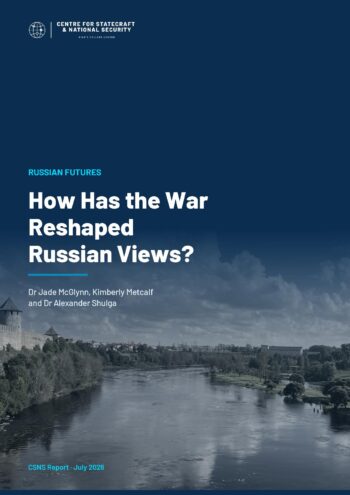
How Has the War Reshaped Russian Views?
By Dr Jade McGlynn, Kimberly Metcalf and Dr Alexander Shulga
Executive Summary:
Over four years of full-scale war have changed how Russians live with the conflict far more than what they believe about it. Drawing on ten waves of telephone polling from December 2022 to May 2026, this report traces a population increasingly exhausted and personally touched by loss, yet still committed to the war’s underlying justification. That gap, between a rising willingness to see the war end and an unmoved conviction on why it is being fought, is the report’s central finding, and the source of its central warning. Western observers should not mistake war-weariness for a constituency that is ready to demand peace or to refuse to accommodate the war. These quantitative findings are supplemented throughout by qualitative fieldwork: semi-structured and in-depth interviews with non-elite Russians, conducted by Kimberly Metcalf between 2023 and 2026 for her PhD dissertation at King’s College London, which illustrate the survey findings at the level of individual lives.
The report is organised in three parts. It first sets out the evidence base and establishes the central pattern: over four years of war, Russians’ relationship to the conflict has changed markedly while the beliefs that justify it have held, so that rising fatigue reflects the cost of the war’s aims rather than any rejection of them. It then reads the population in two complementary ways, through fixed demographic categories such as age, sex, settlement and income, and through attitude segments that sort supporters by stamina rather than sympathy. It closes by turning these findings forward, setting out how opinion is likely to develop, what would move it, and what it cannot be expected to do, before drawing the implications for Western policy.