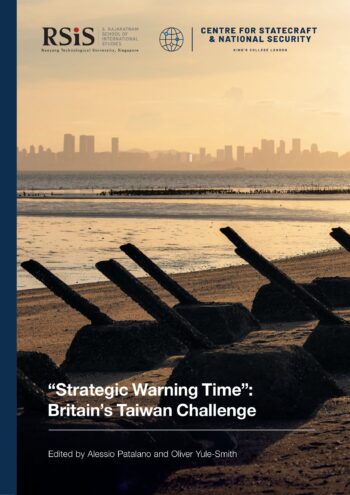
“Strategic Warning Time”: Britain’s Taiwan Challenge
Read Full Report 
Edited by Prof Alessio Patalano and Dr Oliver Yule‑Smith
Executive Summary:
- The study finds that we are in a period of strategic warning time on Taiwan and that the risk of serious escalation around the Strait of Taiwan is a real possibility well within a ten‑year timeframe.
- Direct military action by the People’s Liberation Army (PLA) against Taiwan would be a dangerous conflict, highly destabilising to global trade and security. But if China’s leaders deem force to be necessary, the PLA is well‑organised to the task and China’s diplomats have set the stage for a global information campaign to discourage external intervention.
- The objectives of a PLA campaign would be to rapidly manoeuvre in every domain to overwhelm Taiwan’s defences, hold American and allied regional forces at risk, and quickly gain control over the island before meaningful outside force can be brought to bear.
- The PLA will seek rapid victory, but if Taiwan can withstand the PLA’s initial onslaught, the nature of the conflict could shift from rapid manoeuvre warfare to slower attrition warfare, involving opportunities for other countries to create economic leverage and expand the geographic scope of conflict.
- In the event of an extended period of conflict, the UK’s primary contribution to a Taiwan contingency would be to ensure maritime defence of the North Atlantic on behalf of its NATO allies and exercise greater leadership within NATO as American attention is drawn to the Pacific. The UK may also be asked to help create economic leverage to encourage China to back down.
- To avoid the unpredictability of warfare and the international damage to China’s reputation that the use of military force would entail, Beijing may seek to control Taiwan by employing a strategy of coercion without kinetics, either as a standalone operation or as a precursor to further escalation. This approach would involve Beijing’s increasing use of law enforcement measures to bring Taiwan under China’s jurisdictional control.
- Taiwan’s democratic consensus has solidified around maintaining distance from Beijing, with even traditionally China‑friendly parties now rejecting unification models and supporting increased defence spending. This bipartisan shift toward deterrence reflects a realignment which will likely persist regardless of which party holds power.
- Beijing will continue to escalate grey‑zone activities and military pressure against Taiwan as the island’s political direction moves away from unification, creating recurring cycles of tension which test international resolve. These coercive tactics represent China’s preferred strategy for maintaining pressure without triggering full‑scale conflict, and eventually persuading the Taiwanese people that their situation is futile and their US partners unreliable.
- European nations must develop a more coherent and proactive Taiwan policy which balances support for Taipei against Chinese coercion while coordinating closely with Indo‑Pacific partners. Europe’s ability to forge this balanced approach will determine its credibility as a serious security actor in the region and its capacity to respond to future Strait of Taiwan crises.
- China’s military activity near Taiwan is intensifying, but its ultimate goal is political rather than military: to shape Taiwan’s 2028 elections by eroding public trust and encouraging a shift away from the DPP.
- Beijing may attempt to provoke a limited crisis – not full‑scale war – but only if it can blame Taiwan’s leadership, fracture domestic confidence, and test US resolve without triggering uncontrollable escalation.
- The core variable in Beijing’s calculus is the US: if Washington can be persuaded to view Taipei as the destabilising actor, or if ‘America First’ policies damage Taiwan’s economy, China could exploit the moment to drive a wedge.
- To preserve the status quo, democratic actors should focus their action on reinforcing Taiwan’s resilience, by bolstering critical infrastructure, countering disinformation, protecting foreign investors and clearly signalling to China the risks of crisis manipulation.
- The UK should commit to a ‘national endeavour’ to demand preparedness from businesses, citizens and the public sector, which should be enshrined as a ‘Preparedness Act’ ensuring serious machinery of government changes.
- This national endeavour must be explained, voters persuaded, and our private and public sectors directed and enabled to be resilient.
- The UK has several unique levers to influence Beijing’s decision‑making in a Taiwan crisis. These include the assets held by China’s state‑linked elites in the UK, London’s role in offshore RMB trading and its pivotal role in maritime insurance.
- The UK can multiply its influence by building coalitions to put pressure on Beijing, helping reduce the need for unilateral US action. The UK will likely set the bar for any European military or sanction response to attacks on Taiwan, and should begin working with EU partners now to ensure a swift and coordinated response.
- The UK’s strategic warning time has already begun. It must act now to strengthen its capabilities for a range of Taiwan contingencies. This means boosting strategic capabilities, working with allies on prospective sanctions and other measures, strengthening Taiwan’s ability to deter and defend against Chinese threats, and reducing the UK’s own exposure to Chinese retaliation.
- The UK should be working with EU officials to identify potential sanction targets proportionate to a range of grey‑zone and conflict scenarios, and conduct diplomacy to persuade hesitant member states to align.
- The UK should work with its close partners to signal to China that the continued adherence to so‑called One‑China policies are conditional upon China not forcing a unilateral change to the status quo, with a range of options for moving beyond the confines of longstanding policies on Taiwan in the event of an attack.
- The UK government, through the Cabinet Office, should revive the ‘war books’ of the Cold War, detailing actions to be taken by government departments, arms‑length bodies, critical national infrastructure, important private sector companies and civil society, in the event of a Taiwan crisis.
- The UK government should require public sector and critical national infrastructure digital transformation plans to include a ‘non‑digital redundancy’, detailing how public service providers would try to operate a normal service if their digital systems were compromised.