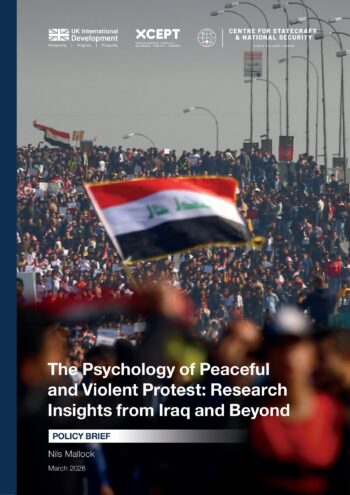
The Psychology of Peaceful and Violent Protest: Research Insights from Iraq and Beyond
By Nils Mallock
Understanding why people participate in political protest – and why some turn to violence while others remain peaceful – is critical for policy responses and practitioner efforts in fragile states. However, existing evidence is largely limited to (relatively) stable democratic settings, and frequently analyses political groups or movements rather than individuals, leaving central questions about the psychological causes of peaceful and violent protest in conflict-affected environments unanswered.
This briefing note summarises findings from large-scale quantitative studies in Iraq, conducted as part of the XCEPT programme, as well as related research on high-risk protest behaviour. On that basis, this note presents practical findings with direct relevance for international and practitioner engagement across fragile and conflict‑affected environments globally, with implications extending well beyond Iraq.
This publication is issued by the Cross-Border Conflict Evidence, Policy and Trends (XCEPT) research programme, funded by UK International Development. XCEPT brings together world-leading experts and local researchers to examine conflict-affected borderlands, how conflicts connect across borders, the intersection of climate stresses and conflict, and the drivers of violent and peaceful behaviour, to inform policies and programmes that support peace.
The views and opinions expressed in this document are those of the author(s) and do not necessarily represent those of the UK government.
This document is issued on the understanding that if any extract is used, the author(s) should be credited, with the date of the publication and reference to XCEPT. While every effort has been made to ensure the accuracy of the material in this document, the author(s) will not be liable for any loss or damages incurred through the use of this document.