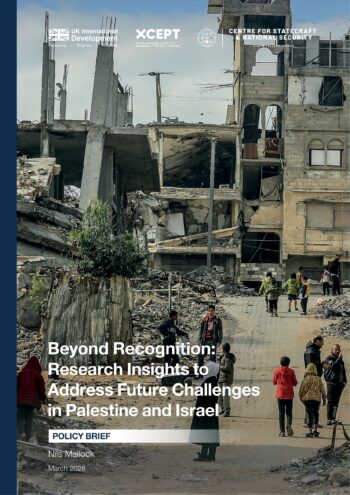
Beyond Recognition: Research Insights to Address Future Challenges in Palestine and Israel
By Nils Mallock
Amid catastrophic levels of violence, displacement and destruction, the Israeli–Palestinian conflict has found itself in a new critical phase since October 2023. The West Bank faces spiralling instability driven by confrontations between growing settler communities, Israeli military forces and Palestinians. Gaza is largely in ruins after two years of war. Even though major powers have moved to formally recognise Palestinian statehood, key questions remain regarding territorial control, unified leadership and the conflict going forward.
This briefing note summarises evidence from field research and large‑scale studies by the author, while also drawing on wider research and regional policy insights. It highlights three thematic areas for urgent attention:
1. The West Bank, with a focus on territorial fragmentation and psychological dynamics of political violence
2. Gaza, with a focus on post‑war reconstruction and governance scenarios
3. Broader challenges for Palestinian statehood and constructive engagement from the UK and the international community.
The primary data supporting this research was collected between 2022 and 2025 across the West Bank, Israel and Gaza by the author in collaboration with various local research institutes and academic collaborators. The West Bank and Gaza today represent not just sites of humanitarian emergency, but a critical test for global diplomacy and development. Formal recognition of a Palestinian state is challenged by the realities of ongoing settlement expansion, unresolved grievances and psychological divides on the ground. Efforts to promote conflict resolution and stable governance must reflect these issues and be forward‑looking in their engagement with key actors. This briefing note presents research insights to inform such engagement and regional developments.
Read the full Policy Brief here.
This publication is issued by the Cross-Border Conflict Evidence, Policy and Trends (XCEPT) research programme, funded by UK International Development. XCEPT brings together world-leading experts and local researchers to examine conflict-affected borderlands, how conflicts connect across borders, the intersection of climate stresses and conflict, and the drivers of violent and peaceful behaviour, to inform policies and programmes that support peace.
The views and opinions expressed in this document are those of the author(s) and do not necessarily represent those of the UK government.
This document is issued on the understanding that if any extract is used, the author(s) should be credited, with the date of the publication and reference to XCEPT. While every effort has been made to ensure the accuracy of the material in this document, the author(s) will not be liable for any loss or damages incurred through the use of this document.