Exploring the Role of Identity in Reconciliation and Radicalisation
By Sarah Carver
The Rwandan Civil War (1990-1994), which was fought between the army and the Rwandan Patriotic Front (RPF) rebel group, was rooted in long-standing tensions between the two main ethnic groups in Rwanda, the Tutsis and the Hutus. The four-year conflict saw the RPF, a group primarily made up of Tutsis who had fled the country when the Hutu government came into power, clash with the government’s armed forces, and eventually culminated in the Rwandan genocide: a three-month period during which extreme Hutus massacred over 800,000 Tutsis and moderate Hutus.[i] In the aftermath of the civil war, the new Tutsi-led government sought to overcome these divisions by creating a unified identity. They proclaimed that there were no Hutus or Tutsis, only Rwandans.
Identity can play a key role in the origins, dynamics, and outcomes of a conflict. Intergroup conflicts can often be traced back to, or exacerbated by, people segregating their personal and their group’s identity from that of the group they are in conflict with. As the barriers between groups are defined, favouritism and superiority are often accredited to members of the ingroup, and there is greater exclusion of the outgroup group. When this occurs in combination with political divides, instability, or a perceived threat, it can increase hostility.[ii] On the other hand, promoting a common identity or encouraging identification with a benevolent group can be useful tools to promote post-conflict reconciliation. Understanding how identity can drive people towards reconciliation or radicalisation can help guide efforts to achieve post-conflict stability.
Group Identity
As identity can cause division between groups, one strategy used to promote reconciliation in the aftermath of a conflict is ‘recategorisation’. This focuses on creating an all-encompassing larger group categorisation that both sides can identify with. The theory is that, by including the outgroup in a shared identity, the favouritism saved for those seen as members of the ingroup will be extended to include the outgroup.[iii] As noted above, reconstructing the national Rwandan identity was one way in which the Rwandan government sought to foster reconciliation following the end of the civil war. Ethnicity was removed from identity cards, and any mention of ethnic groups and identities was banned in the public sphere.iv Although enforcing this shared identity encouraged people to move beyond intergroup antagonism, it proved to be an ineffective method to promote reconciliation, as it limited freedom of discussion, and denied both sides the opportunity to express their grievances.[v] Recategorisation strategies often favour the dominant group, who want to focus on similarities, but they can cause difficulties for the disadvantaged group, who are denied opportunities to highlight power differences and systemic injustices. One study conducted with ‘survivors’ and ‘non-victims’ of the Rwandan genocide in 2009 found that, while the groups did not differ in their level of identification with the nation, the non-victim (i.e. dominant) group were more willing to reconcile than members of the survivor group.[vi]
Dual Identity
Depending on the situation, it is also unrealistic to assume people will be open to replacing one closely held identity with an entirely new, more inclusive one. In some circumstances, it can be more feasible to reframe people’s ideas of their identity by instead encouraging them to hold a dual identity. A dual identity means someone can retain their original identity, but, at the same time, adopt a second more inclusive identity, and it allows for recognition of both the similarities and differences between groups. This was studied in America by asking white Americans about their opinions on policies that were more favourable for ethnic minorities. Those who felt more strongly about their dual identities – identifying as Americans and with their ethnicity group – were more supportive of the policies than those who had more of a connection to their ethnicity than their American identity.[vii] Research in the case of migrants has also found that, when individuals identify with both their minority ingroup and their society of residence, it constrains politicisation, encouraging nonviolent forms of political action that are more likely to be widely accepted as legitimate. When two identities are incompatible, however, there is a risk this could encourage political radicalisation. In such cases, the dominant group has a responsibility to welcome the differences within a dual identity as a ‘promising contribution to a pluralistic society’, rather than treating them as a liability.[viii]
Identity Fusion
Aspects of identity can also fuel extremist behaviour when someone’s personal identity becomes intertwined with that of the group they are a member of. As the identities merge, people begin to view attacks on their group as a personal attack on them. This gives people a sense of responsibility for the group’s wellbeing and makes them more willing to fight back, give support, and risk themselves for the benefit of the group.[ix] It provides feelings of strength and immunity for the individual when they’re acting on behalf of something larger than themselves. The influence identity fusion can have on a person’s behaviour was analysed in a study on self-sacrificing behaviour in Spaniards. The participants’ fusion with their national identity was measured, and they were presented with a hypothetical situation and asked about their willingness to die to save multiple other lives. Those who were more strongly fused with their Spanish identity were more likely to sacrifice themselves for the ‘ingroup’ (fellow Spaniards), but not for the ‘outgroup’ (Americans).[x] Having a strongly fused identity does not just encourage people to engage in radical or violent behaviour, however. If an individual’s identity becomes closely connected with a different group or with family members that do not take part in radical behaviour, it has the capability to move people towards more peaceful actions. One study in Spanish prisons with Latino gangs found fusion with one’s family helped to protect against radicalisation and prompted people to move away from more radical groups and behaviours.[xi]
Conclusion
Exploring the role identity can play in encouraging reconciliation or radicalisation can provide insight into how to mitigate violence in a post-conflict setting. The influence of this factor is highly context dependent, so understanding the intricacies of a conflict is essential to being able to appropriately apply these theories. Interventions aimed at promoting a shared identity and fusion with an alternative identity could aid in the reconciliation process as long as they are adapted for each individual situation. If not, they could have the opposite effect and exacerbate the issue.
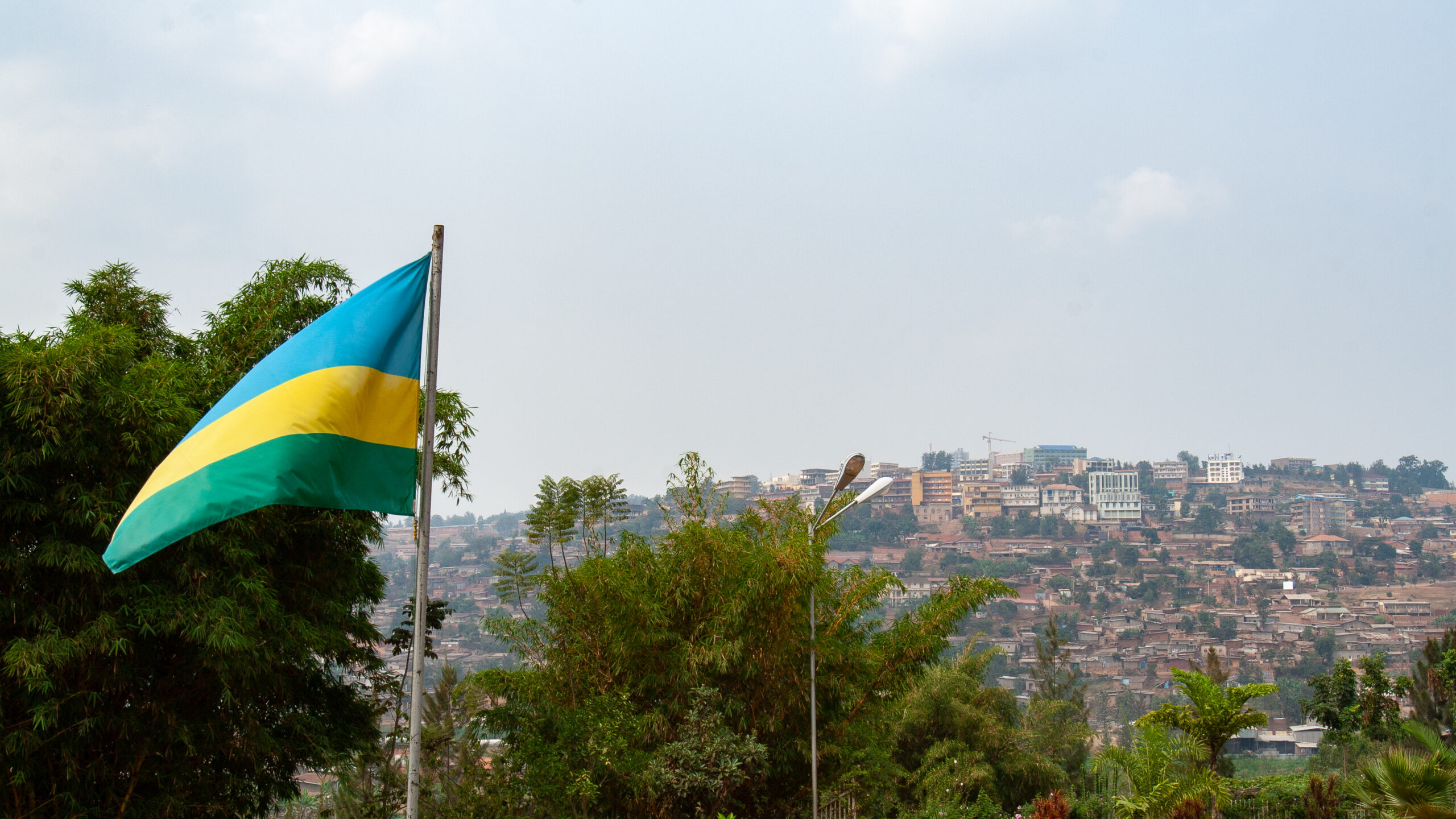
Rwandan flag waving at Kigali Genocide Memorial (August 8th 2008). Credit: MilanoPE / Shutterstock.com
[i] Sentama, E. (2022). National Reconciliation in Rwanda: Experiences and Lessons Learnt. European University Institute.
[ii] Brewer, M. B. (1999). The psychology of prejudice: Ingroup love and outgroup hate?. Journal of Social Issues, 55(3), 429-444. https://doi.org/10.1111/0022- 4537.00126
[iii] Gaertner, S., Dovidio, J., Nier, J., Banker, B., Ward, C., Houlette, M., & Loux, S. (Eds.) (2000). The common ingroup identity model for reducing intergroup bias: Progress and challenges. SAGE Publications Ltd. https://doi.org/10.4135/9781446218617
[iv] Kanazayire, Clémentine, Laurent Licata, Patricia Mélotte, Jean Pierre Dusingizemungu, and Assaad E. Azzi. “Does Identification With Rwanda Increase Reconciliation Sentiments Between Genocide Survivors and Non-Victims? The Mediating Roles of Perceived Intergroup Similarity and Self-Esteem During Commemorations.” Journal of social and political psychology 2, no. 1 (2014): 489–504.
[v] Staub, E. (2014). The challenging road to reconciliation in Rwanda: Societal processes, interventions and their evaluation. Journal of Social and Political Psychology, 2(1), 505-517. https://doi.org/10.5964/jspp.v2i1.294
[vi] Kanazayire, Clémentine, Laurent Licata, Patricia Mélotte, Jean Pierre Dusingizemungu, and Assaad E. Azzi. “Does Identification With Rwanda Increase Reconciliation Sentiments Between Genocide Survivors and Non-Victims? The Mediating Roles of Perceived Intergroup Similarity and Self-Esteem During Commemorations.” Journal of social and political psychology 2, no. 1 (2014): 489–504.
[vii] Huo, Y. J., Smith, H. J., Tyler, T. R., & Lind, E. A. (1996). Superordinate identification, subgroup identification, and justice concerns: is separatism the problem: Is assimilation the answer? Psychological Science, 7(1), 40- 45. https://doi.org/10.1111/j.1467-9280.1996.tb00664.x
[viii] Simon, B., Reichert, F., & Grabow, O. (2013). When Dual Identity Becomes a Liability: Identity and Political Radicalism Among Migrants. Psychological Science, 24(3), 251-257. https://doi.org/10.1177/0956797612450889
[ix] Gómez, Á, Brooks, M. L., Buhrmester, M. D., Vázquez, A., Jetten, J., & Swann, W. B., Jr. (2011). On the nature of identity fusion: Insights into the construct and a new measure. Journal of Personality and Social Psychology, 100(5), 918-933. https://doi.org/10.1037/a0022642
[x] Buhrmester, M., & Swann, W. (2015). Identity Fusion. In Emerging trends in the social and behavioral sciences: An interdisciplinary, searchable, and linkable resource. John Wiley & Sons; Swann, William B., Ángel Gómez, John F. Dovidio, Sonia Hart, and Jolanda Jetten. “Dying and Killing for One’s Group: Identity Fusion Moderates Responses to Intergroup Versions of the Trolley Problem.” Psychological science 21, no. 8 (2010): 1176–1183.
[xi] Gómez, A., Atran, S., Chinchilla, J., Vázquez, A., López-Rodríguez, L., Paredes, B., … & Davis, R. (2022). Willingness to sacrifice among convicted Islamist terrorists versus violent gang members and other criminals. Scientific Reports, 12(1), 1- 15. https://doi.org/10.1038/s41598-022-06590-0

This publication is issued by the Cross-Border Conflict Evidence, Policy and Trends (XCEPT) research programme, funded by UK International Development. XCEPT brings together world-leading experts and local researchers to examine conflict-affected borderlands, how conflicts connect across borders, the intersection of climate stresses and conflict, and the drivers of violent and peaceful behaviour, to inform policies and programmes that support peace.
The views and opinions expressed in this document are those of the author(s) and do not necessarily represent those of the UK government.
This document is issued on the understanding that if any extract is used, the author(s) should be credited, with the date of the publication and reference to XCEPT. While every effort has been made to ensure the accuracy of the material in this document, the author(s) will not be liable for any loss or damages incurred through the use of this document.