King’s College London (KCL) and the Research Institute for Peace and Security (RIPS) are pleased to host a seminar to discuss the current maritime security challenges in East Asia in-depth.
The year 2026 will mark the tenth anniversary of the South China Sea Arbitration Award of the Permanent Court of Arbitration (PCA). Despite the PCA’s denial of China’s claims, including the “Nine-Dash Line,” China disregards the award and is increasingly assertive in the South China Sea, including by building military facilities on artificial islands and by heavily damaging the marine environment. The South China Sea issue is not a regional challenge but a serious global challenge as the sea is one. All of us are connected by the sea and keep growing on the water. Also, the South China Sea today may be the East China Sea tomorrow. Japan cannot be indifferent to the events in the South China Sea.
China’s maritime expansion in the South China Sea is not only military. China has been engineering gray zone and hybrid warfare, which is more difficult for weaker regional countries to address. China Coast Guard (CCG) disturbed the Philippines’ replenishment in the Second Thomas shoal. In August, a CCG vessel chasing the Philippine Coast Guard vessel collided with a PLA Naval ship in the waters surrounding the Scarborough Shoal, which showed their lack of seamanship.
The gray zone and hybrid warfare is difficult to deter. Defense by all instruments of national power and by international partnership is increasingly important. Current momentum for cooperation among like-minded countries in the Indo-Pacific region, including the Quad countries, i.e., Japan, the United States, and Australia, and India, must be maintained and even accelerated.
Today, the security of Europe and that of East Asia have become increasingly interlinked particularly after the Russian invasion of Ukraine. Reflecting this, security cooperation between Europe and Japan has also made significant progress. This summer, the United Kingdom deployed its carrier strike group to the Indo-Pacific, with HMS Prince of Wales calling at Yokosuka in Japan. In December 2023, the U.K., Japan and Italy launched a joint development program for a new combat aircraft, i.e., the Global Combat Air Programme (GCAP). Japan and NATO agreed on Individually Tailored Partnership Programme (ITPP) in July 2023. Japan is working together as a partner country of NATO in the Indo-Pacific. Japan and EU released the European Union-Japan Security and Defense Partnership in November 2024 in order to enhance security cooperation in a variety of functional areas including maritime security.
Intellectual community must contribute to such international efforts to maintain the rules-based maritime order by promoting and sharing correct understanding of the acute security environment of East Asia and of the importance of the fundamental principle of the rule of law.
Sense of community and habit of cooperation are growing in the Indo-Pacific region. We must capitalize on this regional trend. Bilateral and mini-lateral initiative in regional security terms should be synergized, particularly to enhance maritime domain awareness in the huge maritime expanse.
This seminar will look into the relevance of the South China Sea Arbitral Award in today’s context and the impact of China’s assertiveness on the regional maritime security. Based on shared recognition of these points among the experts, the seminar will look into how we should and can address those serious challenges. Questions include: What is the current state of maritime security cooperation in the region?; What will be the future of the regional security architecture?; How should the U.S. alliance network be intertwined in it; and what roles should the Quad, AUKUS, ARF, ADMM, and ADMM+ play?
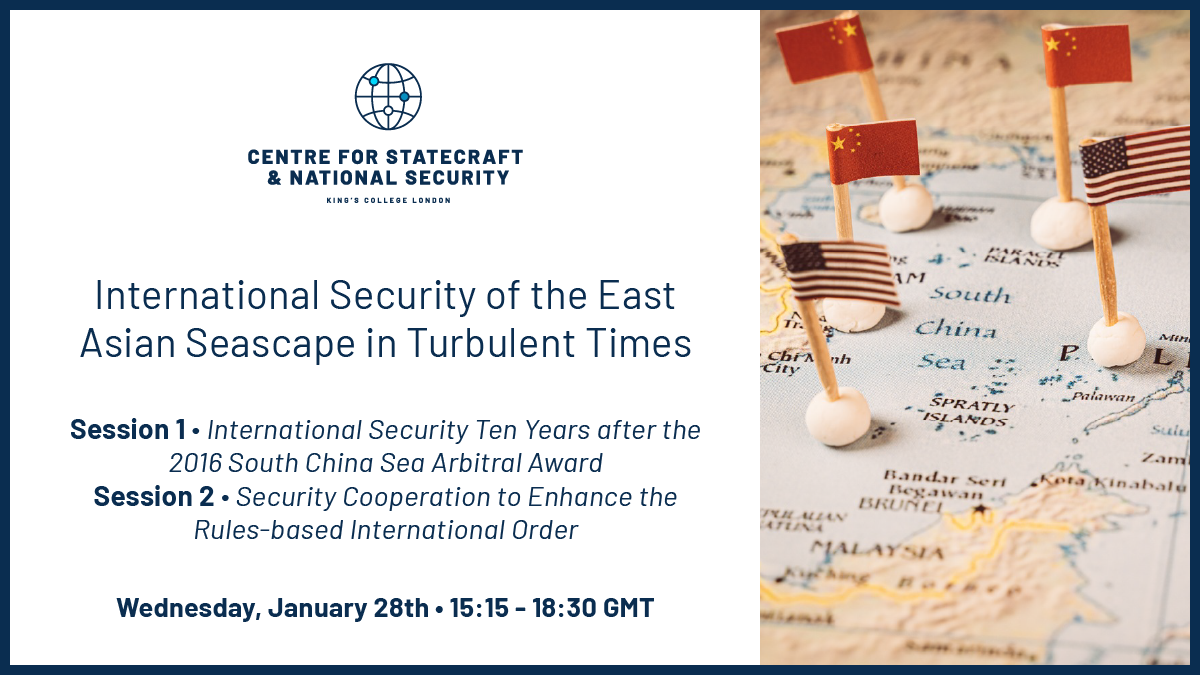
Schedule:
15:15 – 15:25 Welcoming Remarks
15:25 – 16:40 Session 1: International Security Ten Years after the 2016 South China Sea Arbitral Award
- Chair: Prof Alessio Patalano, Professor of War & Strategy in East Asia, Centre for Statecraft and National Security
- Jane Chan Git Yin, Rajaratnam School of International Studies, Singapore
- Admiral Tomohisa Takei, former Chief of Staff of the Japan Maritime Self-Defense Force
16:40 – 16:55 Coffee Break
16:55 – 18:30 Session 2: Security Cooperation to Enhance the Rules-based International Order
- Chair: Hideshi Tokuchi, President, RIPS
- Prof Charmaine Misalucha-Willoughby
- Dr Alexandra Sakaki, German Institute for International and Security Affairs (SWP)
- Prof Ruhanas Harun, National Defence University of Malaysia
To register to attend, please click here.
