Tangle of Trauma Webinar Recording
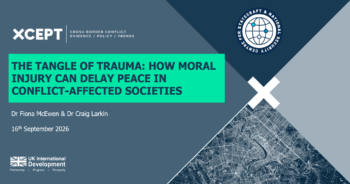
The XCEPT team held the webinar ‘The Tangle of Trauma: How Moral Injury Can Delay Peace in Conflict-Affected States‘ on 16 September 2026.
Dr Fiona McEwen discussed findings from the programme’s Impact of Trauma Survey conducted in Iraq, Lebanon and South Sudan. She highlighted the importance of context when considering moral injury. For example, conflicting evidence from the survey suggests that moral injury increased the desire for revenge and support for violence in Iraq, while in Lebanon it decreased that sentiment. She emphasised that the nature and timing of conflict exposure, as well as other factors, such as trust in institutions, needed to be understood to determine the influence moral injury might have in any given context.
Dr Craig Larkin’s talk drew on research from Lebanese hostage families, moral injury and the legacy of the Arsal kidnappings. He put forward the following policy implications from his research on moral injury: acknowledging moral injury in a hostage crisis; strengthening state legitimacy and public trust; developing tailored support for moral injury recovery; adopting restorative justice measures; and, in the specific case of Arsal, establishing a public inquiry into the crisis.
Watch the full webinar, which is made up of two 20-minute presentations from the researchers and a 20-minute Q&A with participants.
This article is issued by the Cross-Border Conflict Evidence, Policy and Trends (XCEPT) research programme, funded by UK International Development. XCEPT brings together world-leading experts and local researchers to examine conflict-affected borderlands, how conflicts connect across borders, the intersection of climate stresses and conflict, and the drivers of violent and peaceful behaviour, to inform policies and programmes that support peace.
The views and opinions expressed in this document are those of the author(s) and do not necessarily represent those of the UK government.