Six Years On, the Beirut Port Explosion is Still Not Over
Maya Yamout is Vice President of Rescue Me, an NGO working on rehabilitation, crime prevention and trauma-informed care. She has more than 15 years of experience in forensic social work, countering violent extremism, prison work and psychosocial intervention in conflict zones – and has interviewed over 100 men held in Roumieh prison on terrorism charges. She has supported XCEPT over recent years, including research on the Arsal kidnapping crisis in Lebanon, when she interviewed hostages’ families.
One of thousands of people injured in the 2020 Beirut port explosion, Maya Yamout gives her perspective on how the disaster continues to shape Lebanon six years on.
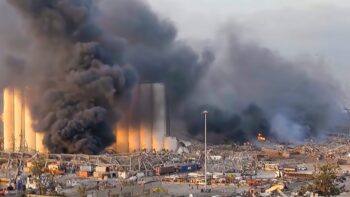
On 4 August 2020, more than 2,700 tonnes of improperly stored ammonium nitrate detonated at Beirut’s port. The blast – among the largest non-nuclear explosions on record – sent a shockwave across the city that killed more than 200 people,[i] injured thousands, displaced 300,000 and left entire neighbourhoods in ruins.
Shattered glass from the blast left me with a fractured foot and injuries to my head, shoulder and arm. My strongest memory is not the physical pain but standing beneath the pink mushroom cloud rising over the city, unable to take in what had happened. Strangers helped me reach a hospital outside Beirut, where the emergency department was overwhelmed and families were searching for missing relatives.
So many survivors’ stories are marked by loss, injury and the slow realisation that no one would be held responsible. The explosion was not an unavoidable accident. The authorities knew the ammonium nitrate had been stored at the port since 2014, and they knew the danger it posed. It was the culmination of years of institutional negligence and political paralysis.
Now, six years later, much of the physical damage has been repaired – unevenly, and largely at private expense. Beneath that appearance of recovery lies something that continues to shape the lives of survivors and the future of the country. The explosion should not be understood as a single event confined to one afternoon in August 2020, but as an ongoing crisis sustained by impunity.
Six years without accountability
The harm since the explosion has not only been the scale of the destruction, but the failure of the Lebanese state to establish who was responsible. The pattern began before the explosion: Lebanon has a long record of impunity, including unsolved political killings and powerful figures escaping consequence for violence against citizens.[ii]
President Aoun and Prime Minister Salam, who took office in January 2025, both committed publicly to seeing the investigation completed.[iii] In March 2026 the investigation was finally concluded and the file referred to the public prosecutor, with 70 people implicated. That is further than the case has ever come. But no indictment has yet been issued, no one has stood trial, and no one has been held to account. For survivors, time has not diminished the demand. Whether those commitments hold through indictment and trial is one of the defining questions facing Lebanon.
When the state fails, communities keep the score
In the absence of state action, Lebanese society has refused to let the disaster fade from public memory. Families of the victims organise monthly demonstrations. Civil society organisations have documented evidence, supported survivors and sustained pressure on political institutions.
The most enduring symbol of that effort is the grain silos. Standing 48 metres high, immediately beside the epicentre, they absorbed a substantial part of the blast and shielded parts of western Beirut from greater destruction. Catastrophically damaged and once slated for demolition, their ruins still stand. They have become an unofficial memorial to the explosion, and to the negligence behind it.
Unresolved disasters do not stay in the past. Research on collective trauma shows that mass violence affects societies long after physical reconstruction is complete (see for example Hirschberger, 2018[iv]). The absence of accountability erodes public trust, deepens political polarisation and weakens social cohesion. Communities grow sceptical of institutions that appear unable either to protect them or to hold anyone answerable.
The consequences therefore reach well beyond survivors and bereaved families: they reshape the relationship between citizens and the state. In Lebanon, this is compounded by a political settlement built on sectarian power-sharing and on the 1991 amnesty law, which closed off accountability for the civil war and established that grave harm could pass without consequence.
Healing is not justice
These dynamics have never been purely abstract for me. I have continued to experience complications requiring repeated medical treatment. But my injuries are not just physical: I was eventually diagnosed with post-traumatic stress disorder, and despite being a social worker and therapist myself, and despite intensive therapy, my psychological injuries have proved even more persistent than my physical injuries.
While the explosion injured me, the absence of accountability kept the wound open. Every delay in the investigation felt like reopening a wound that had begun to close. Therapy has taught me that healing is possible. Yet it also taught me that healing and justice are not the same thing, and that survivors deserve both.
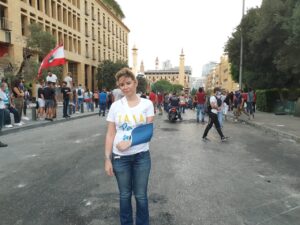
Maya in central Beirut shortly after the explosion (used with permission).
Impunity and the afterlife of violence
Impunity does not only affect the victims of past violence, it can also make disengagement from violence harder. My experience as a blast survivor eventually intersected with my work as a researcher. Living through the blast and its aftermath gave me a heightened sensitivity to how injustice shapes people’s view of the world. Interviewing men held in Roumieh prison on terrorism charges, I recognised echoes of my own anger – the same frustration, the same sense of betrayal – amplified and channelled in dangerous directions. In those interviews I repeatedly encountered accounts in which state injustice was offered as evidence that violence remained justified: some claimed that if the powerful are never held to account, then peaceful political engagement is pointless and those who pursue it are naive.
This relationship deserves more attention than it receives. Justice is primarily a moral obligation for the Lebanese government, and it also does practical work. Institutions that demonstrate fairness give people reason to believe that peaceful routes produce results. Institutions that consistently fail to do so weaken one of the foundations on which desistance and reconciliation depend.
Six years on, Lebanon has a new government that has committed itself to accountability and an investigation that has, at last, reached the prosecutor. However, it also has a crisis of public trust that no single case can resolve. For survivors, the question extends beyond these proceedings to whether future generations will inherit state institutions capable of protecting them.
The Beirut port explosion should not become an anniversary marked only by ceremony. Until the truth is established and accountability delivered, the explosion is still not over. Its consequences continue to unfold – not only in damaged buildings or courtrooms, but in the bodies, minds and daily lives of those who carry them.
[i] Casualty figures for the explosion differ, and the discrepancy is itself part of the dispute over accountability. The Lebanese government has cited 191 deaths; the figure most widely reported internationally is 218; and Maan, a Lebanese organisation advocating for victims and survivors, has put the toll at 236. This piece uses “more than 200” for this reason.
[ii] The Monthly (2021) 220 Political Assassinations and Murder Attempts in Lebanon (1943–2021) Available at: https://monthlymagazine.com/en/article/4964/220-political-assassinations-and-murder-attempts-in-lebanon-1943-2021;
Chidiac, E (2022) Lebanon’s Unsolved Political Killings: A Brief Recent History. Available at: https://iranwire.com/en/world/103366-lebanons-unsolved-political-killings-a-brief-recent-history/ (Accessed: 3 August 2026).
[iii] The Tahrir Institute for Middle East Policy (2026) The Prolonged Chapters of the Investigations into the Beirut Port Blast. Available at: https://timep.org/2026/04/22/the-prolonged-chapters-of-the-investigations-into-the-beirut-port-blast/ (Accessed: 3 August 2026).
[iv] Hirschberger, G (2018) ‘Collective Trauma and the Social Construction of Meaning’, Frontiers in Psychology Volume 9 https://doi.org/10.3389/fpsyg.2018.01441
Read more on memory and post-conflict reconstruction:
A New Era for Lebanon: Can an End to Political Posters in Beirut Challenge Sectarian Divides?
Memory, violence and post-conflict reconstruction: rebuilding and reimagining Mosul
This article is issued by the Cross-Border Conflict Evidence, Policy and Trends (XCEPT) research programme, funded by UK International Development. XCEPT brings together world-leading experts and local researchers to examine conflict-affected borderlands, how conflicts connect across borders, the intersection of climate stresses and conflict, and the drivers of violent and peaceful behaviour, to inform policies and programmes that support peace.
The views and opinions expressed in this document are those of the author(s) and do not necessarily represent those of the UK government.