One Thousand and One Interviews: Lessons from Qualitative Research in the Middle East
By Rajan Basra, Fiona McEwen & Tamara Demasi
For all the attention on conflict zones, whether through political debate, social commentary, or a flood of hot takes on social media, there is often relatively little high-quality empirical data about the experiences of people living through the conflict. How exactly are people affected by conflict and violence? How do people remember and memorialise events? Does this hold across time, geographies, and sociodemographic groups? And what does all of this mean for policies regarding, say, justice and reconciliation? Here, qualitative interviews can give rich insight.
On the XCEPT project at King’s College London, we are answering such questions by conducting hundreds of qualitative interviews across Iraq and Lebanon, in collaboration with a team of 65 local interviewers from IIACSS. We have carried out a mix of semi-structured interviews, with questions aligned with our research questions, and oral history interviews that use a more open-ended format. Our research participants have an array of backgrounds (rich and poor), locations (urban and rural; centre and periphery), ethnicities (majority and minority groups), and religions that reflect the demographics of the countries. We interviewed men and women of all ages at home to ensure wider participation. Many also have a range of traumatic experiences: from losing loved ones who have been “disappeared”, to having to flee their homes in the face of war, and almost everything in between. Conducting these interviews has involved many challenges – chiefly from working in high-fear, high-trauma contexts – that reveal lessons for conducting qualitative interviews in the Middle East.
The interview context
To conduct high-quality research, it is important to ensure that sufficiently large and diverse samples are recruited, that interviews are well-designed, and that appropriate analytical approaches are used. However, for all the focus on the technical aspects of research design, we are ultimately basing our work on human interaction. Our macro-level data is comprised of hundreds of individual micro-level interviews. We need to keep in mind that the interview setting is fraught with risks in gathering reliable, insightful data. We know, for instance, that the interviewer’s behaviour, appearance, and voice can unconsciously or consciously influence how a participant responds (known as “interviewer effects”). There can also be problems with inadvertently using leading questions (“How do you feel living in a country that doesn’t deliver justice?”), using rapid-fire, closed questions, or interrupting replies, especially if it feels as if there is time pressure to complete interviews quickly because participants are busy or the interview is interrupted (common challenges when interviewing people in their own homes).
That is before even getting to the themes of these interviews. Imagine sitting down with a stranger who asks you questions about some of the most personal and intimate episodes of your life, such as the loss of a loved one due to war and your desires for revenge upon those you hold to blame. Would you find it liberating to know that your responses were anonymised and that you were free of judgment from someone you likely will not meet again? Or would you feel pressured and close up, not wanting to revisit traumatic memories?
Going deeper when faced with closed responses
Being human means wanting to be heard and feel valued, and sometimes it only takes a nudge for someone to share what is really on their mind. Knowing when to nudge – and what the right follow-up prompt should be – is, of course, the tricky part and depends on the interviewer’s emotional intelligence and judgment. In one interview in Anbar, Iraq, a participant briefly mentioned – almost in passing – their brother’s intense sense of justice and sacrifice. After the participant finished speaking, the interviewer simply asked, “Tell me about his sense of justice and sacrifice.” What followed was a lengthy and profound personal story about the family’s difficulties in enduring the sanctions imposed on Iraq and their internal dynamics in dealing with loss.
An alternative way to help respondents feel more comfortable with sharing their experiences is to encourage storytelling. This allows participants to retell their experiences on their own terms and is less shaped by the researchers’ assumptions than asking predefined interview questions. For some participants, we laid out a series of cards, each with an image (e.g., someone cheating to win noughts and crosses) and a corresponding word (e.g., واسِطة or wasta, meaning the leverage of personal connections to gain favour), linked to research themes we are interested in. The interviewer then invited them to pick one or more cards and share a story that was brought to mind. In most cases, responses to this open-ended format – known as an oral history – have been much more personal, powerful, and in-depth than those in the semi-structured interviews we conducted. The feedback was positive: one Turkman participant mentioned that it was the first time she had been able to express herself after everything she had gone through during the ISIS-related war, which brought her a sense of cathartic relief.
Learning to dance (around the issue)
Sometimes interviewers need to “dance around” the issues, as being too direct may break rapport and lead people to close up. For instance, the role of some non-state armed groups in Iraq is a sensitive topic. In Shia areas, these groups are often seen as legitimate and protective forces, so people may hesitate to criticise them. In Sunni areas, however, the same groups are frequently viewed as causing destruction, which makes it difficult for participants to say anything positive about them. In both cases, asking very direct questions can make people uncomfortable and less willing to speak openly.
Instead, indirect approaches can work well. For instance, it may be too sensitive to ask people from Hezbollah-supporting Shia communities in Lebanon whether they felt disappointed by the lack of support from Iran during the recent Israel-Hezbollah war. A more subtle way may be mentioning how conspiracy theories are circulating in Lebanon that the Iranian leadership was compromised, which in turn jeopardised Hezbollah leaders. This brings up the issue in a roundabout way, inviting the participant to share their opinion without feeling obliged to endorse a particular view.
At other times, people may only make oblique references to specific people, organisations/political parties, or countries. Adjusting to this (intentional or unintentional) self-censorship is important, and – depending on the situation – it may be better to address the issue head-on. For instance, one Shia Lebanese participant stated, “We aren’t being forgiven” by Christian groups in Lebanon. This ambiguous comment begs the question, who is “we” and what does the denied “forgiveness” relate to? The interviewer repeated what they said and asked for clarification: “There’s something I didn’t understand. You said the [the Christian forces] didn’t forgive you and are violently enacting revenge. What is it that they didn’t forgive you for? Just so I can understand”. In response, the participant stated that other Lebanese actors were punishing Hezbollah for “fighting Israel”, thus clearing up the ambiguity.
Participant fear
A recurring challenge throughout our interviews has been the participants’ fear. This is especially pronounced in Lebanon, and it can be localised. For instance, in towns where Hezbollah enjoys significant support, there is currently a lot of tension, and people have been reluctant to engage with our researchers. Some of this is a result of the “pagers attack” in September 2024, when Israel detonated explosives that they had concealed in thousands of pagers and walkie-talkies used by Hezbollah. It was the culmination of a Mossad operation that used front companies to compromise Hezbollah’s supply chain. Consequently, there is a general fear and anxiety among many in the country that they are being watched and that organisations may not be what they appear to be.
This fear and scepticism naturally extend to being interviewed. When informed that we intended to record the interviews to enable accurate transcription and translation, some have asked: “Why are you spying on me?” In such cases, we reassure them about our ethics process and data management, and, besides, we have only conducted interviews with people who are happy to participate and give informed consent. If they are unwilling to participate, we thank them for their time and try to find others. To improve response rates, we paired participants with interviewers who had a similar religious or ethnic background and a shared history of experiencing conflict. The idea was that participants would feel more comfortable speaking with ‘insiders’ rather than ‘outsiders’, thereby strengthening trust, rapport, and understanding.
Some view it suspicious that King’s College London (a foreign organisation) is working with locals; some Shia have explicitly stated they are worried that their interview with us would somehow find its way to Israel. Others are nervous about their views appearing on social media or in the press, with negative repercussions. But there are two fascinating, divergent responses. The first comes from people who say they oppose the government and do not want their heartfelt opinions broadcast further: “I don’t want them to know I’m against them” is a common refrain. But others are vocal and seem proud about their opposition: “I don’t care who’s recorded – I don’t care who listens, I want people to know that I’m against the government, that I’m with Hezbollah”.
Psychological first aid
As the interviews would likely lead some participants to discuss traumatic experiences, we trained the interviewers on when and how to use trauma-informed approaches and psychological first aid techniques to avoid re-traumatising participants. We worked with CrisisCare.eu, an organisation that specialises in working with people recently exposed to conflict and natural disasters, to provide this training. Our interviewers were taught to recognise the different ways a participant might react to the discussion and the appropriate responses.
Everyone has their own “window of tolerance” – that is, the optimal zone of arousal in which one is calm, alert, and can tolerate the stressors and pressures of everyday life. This window can become narrower if an individual experiences trauma (as many of our participants have), meaning that stressors are more likely to affect them. Outside the window of tolerance are two states: hyperarousal (when someone feels agitated, restless, or even angry) and hypoarousal (when they feel emotionally detached, numb, and begin to dissociate).
Interviewers should react differently to both states. If a participant is in a hyperarousal state, it is important to take a break, offer a glass of water, or engage in calming breathing exercises. Hypoarousal suggests it is time for a brief walk to revitalise the interviewee and return to the present moment. Doing so allows the participant to re-enter their window of tolerance and for the interview to continue (if the participant wishes) – it is thus both an ethical intervention and a methodological necessity.
Researcher wellbeing: personal trauma
Hand in hand with the participant’s wellbeing is the researcher’s wellbeing. This aspect is, sadly, often overlooked within social sciences, even though many in our research team were at risk of something more immediate: the triggering of their own primary trauma. Our local researchers were often directly affected by the same traumatic experiences that the interviews covered. Some of our Lebanon team, for instance, were in the blast radius of the 2020 Beirut Port explosion, or were displaced or lost their homes in the recent Hezbollah-Israel war. Our Iraqi researchers lived through Saddam Hussein’s Anfal campaign in the 1980s, the sanctions regime in the 1990s, the US-led invasion and occupation in the 2000s, and were displaced by the emergence of ISIS in the 2010s. Discussing these events during interviews can cause researchers to relive their trauma.
Their personal experiences inevitably affect how researchers conduct interviews. At its best, they may help them to ask empathetic and perceptive questions. However, there is the risk of avoiding certain topics that match their own experiences of trauma, or overly probing interviewees’ responses to understand how and why their reactions differed from their own. At its worst, these personal experiences can lead a researcher to become overly invested in participants’ responses, resulting in loaded questions, unacknowledged responses, and even friction between researcher and participant. Staying professional in these situations is key.
Taking adequate breaks can be a way of mentally ‘resetting’ and disengaging from completed interviews. This was particularly relevant when our team heard emotionally demanding stories, such as in Nineveh. One interviewer noted that, despite having personally lived through the ISIS conflict, certain stories shared during those interviews were especially difficult to process. Having pauses – whether lasting just a few hours to more substantial breaks of a day or more – supports the interviewer’s wellbeing and also ensures consistency across interviews. The same coping methods were used with those processing interviews.
Vicarious traumatisation
It is also known that people conducting and processing interviews with trauma survivors are at risk of vicarious or secondary traumatisation. That is when indirect exposure to trauma (such as listening to the testimonies of people who have lived through civil war) leads to symptoms of primary trauma, such as anxiety, depression, or feelings of helplessness. Many factors can affect the extent to which a researcher experiences vicarious trauma, such as whether they have a stressful work environment or are prone to blur boundaries between professional and personal lives.
It is important to spot signs of traumatisation early and for researchers to be in tune with their own stress signals. Vicarious trauma has its unique signs, such as feelings of bystander guilt or being preoccupied with thoughts of interviewees outside of the work environment. Another is over-identifying with the interviewee, which can manifest in fantasies of rescuing a participant. Coping methods vary from person to person and can include mindfulness body scans, breathing exercises (such as “box breathing” or 4-7-8 breaths), going to work well-rested, and celebrating successes (however small). When hearing stories about war and violence (many in our sample had lost loved ones in the most tragic of circumstances), it is also important to cultivate a sense of hope. Creating a team culture where these concerns can be shared, where there is peer support, and where supervisors are trained to look for signs of burnout, is also crucial here.
How can we conduct better quality interviews?
These various challenges – surface-level responses, learning to dance around the issue, dealing with participants’ fear, and concerns over trauma – can all be overcome. One thing we found particularly useful was having regular check-ins and feedback workshops with the interviewers. These were opportunities for us to hear firsthand from their experiences and learn what did and did not work, with our King’s College London team providing training and tips. And this learning experience wasn’t only one-way. These same workshops were a space for the local team to share insights into the realities of the interview process, offering ways to approach sensitive topics and navigate local and time-specific dynamics. By nature, this is an iterative and slower process, involving regular reviews of interview transcripts and in-depth discussions with the team, but it results in much richer interviews that better reflect the true experience of conflict.
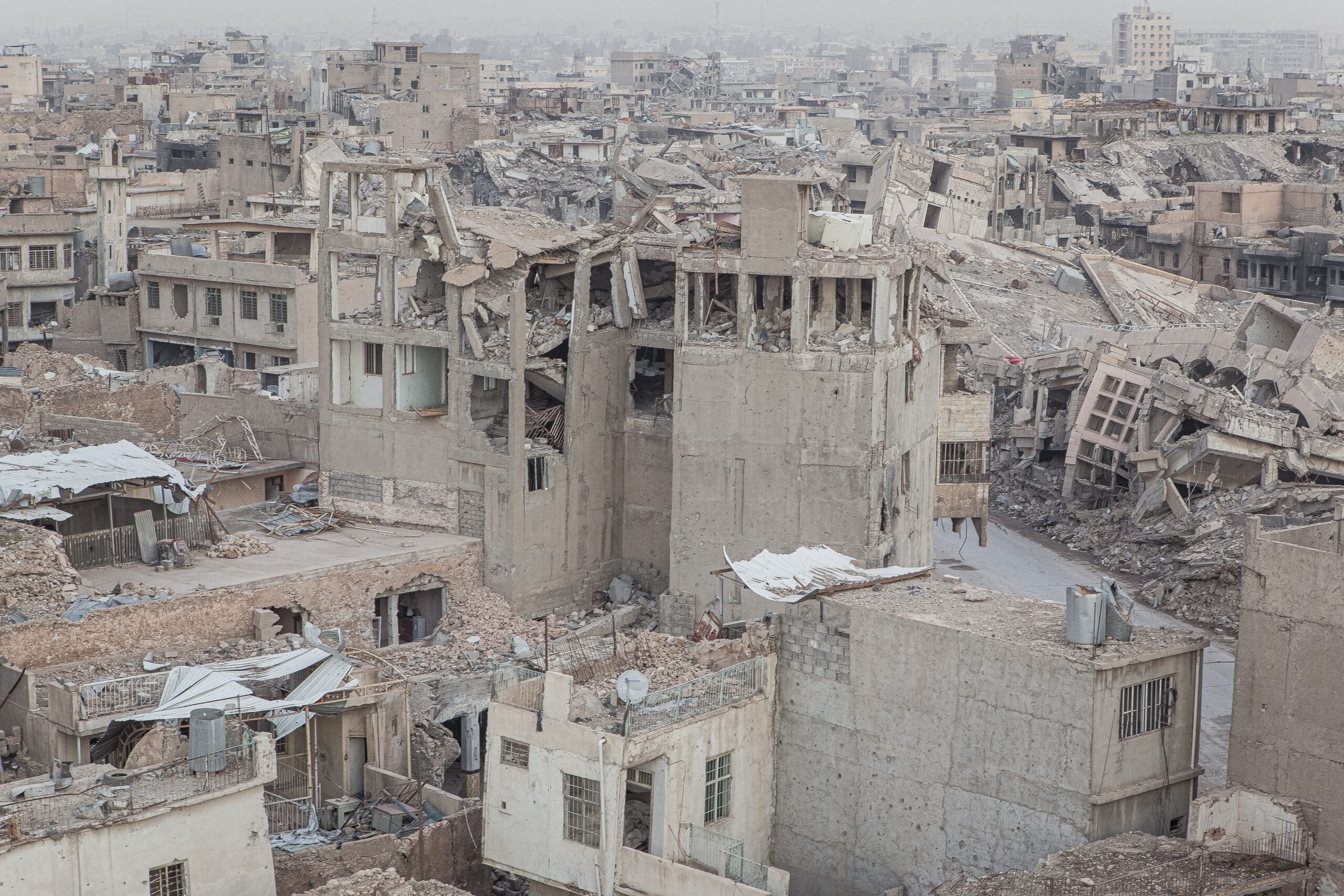
Destruction from fighting against the Islamic State in Mosul, Iraq (January 24th, 2018). Credit: Sebastian Castelier / Shutterstock.com
This publication is issued by the Cross-Border Conflict Evidence, Policy and Trends (XCEPT) research programme, funded by UK International Development. XCEPT brings together world-leading experts and local researchers to examine conflict-affected borderlands, how conflicts connect across borders, the intersection of climate stresses and conflict, and the drivers of violent and peaceful behaviour, to inform policies and programmes that support peace.
The views and opinions expressed in this document are those of the author(s) and do not necessarily represent those of the UK government.
This document is issued on the understanding that if any extract is used, the author(s) should be credited, with the date of the publication and reference to XCEPT. While every effort has been made to ensure the accuracy of the material in this document, the author(s) will not be liable for any loss or damages incurred through the use of this document.