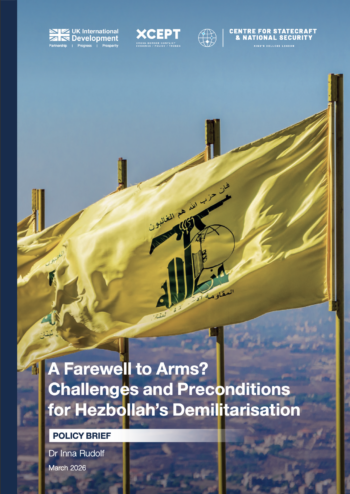
A Farewell to Arms? Challenges and Preconditions for Hezbollah’s Demilitarisation
By Inna Rudolf
This briefing note considers whether Hezbollah can be sustainably demilitarised amid the current US-Israel-Iran escalation and its spillover into Lebanon, and what minimum preconditions would be required for demobilisation to hold.
Based on recent interviews with Hezbollah members, southern residents and Lebanese officials, it moves beyond binary debates about the decommissioning of weapons to highlight the environment (bi’a) of structural grievances, state absence, and perceived threats to dignity and security, which have sustained armed mobilisation.
It argues that as threat perceptions and the human toll of Israel’s retaliation rise, durable progress depends not on a mere technical handover of arms but on the state rapidly demonstrating a credible guarantee of security, livelihoods, and dignity for communities in southern and eastern Lebanon. This would address the social and political wounds that produced and legitimised the entrenchment of the Iran-sponsored resistance movement.
This publication is issued by the Cross-Border Conflict Evidence, Policy and Trends (XCEPT) research programme, funded by UK International Development. XCEPT brings together world-leading experts and local researchers to examine conflict-affected borderlands, how conflicts connect across borders, the intersection of climate stresses and conflict, and the drivers of violent and peaceful behaviour, to inform policies and programmes that support peace.
The views and opinions expressed in this document are those of the author(s) and do not necessarily represent those of the UK government.
This document is issued on the understanding that if any extract is used, the author(s) should be credited, with the date of the publication and reference to XCEPT. While every effort has been made to ensure the accuracy of the material in this document, the author(s) will not be liable for any loss or damages incurred through the use of this document.